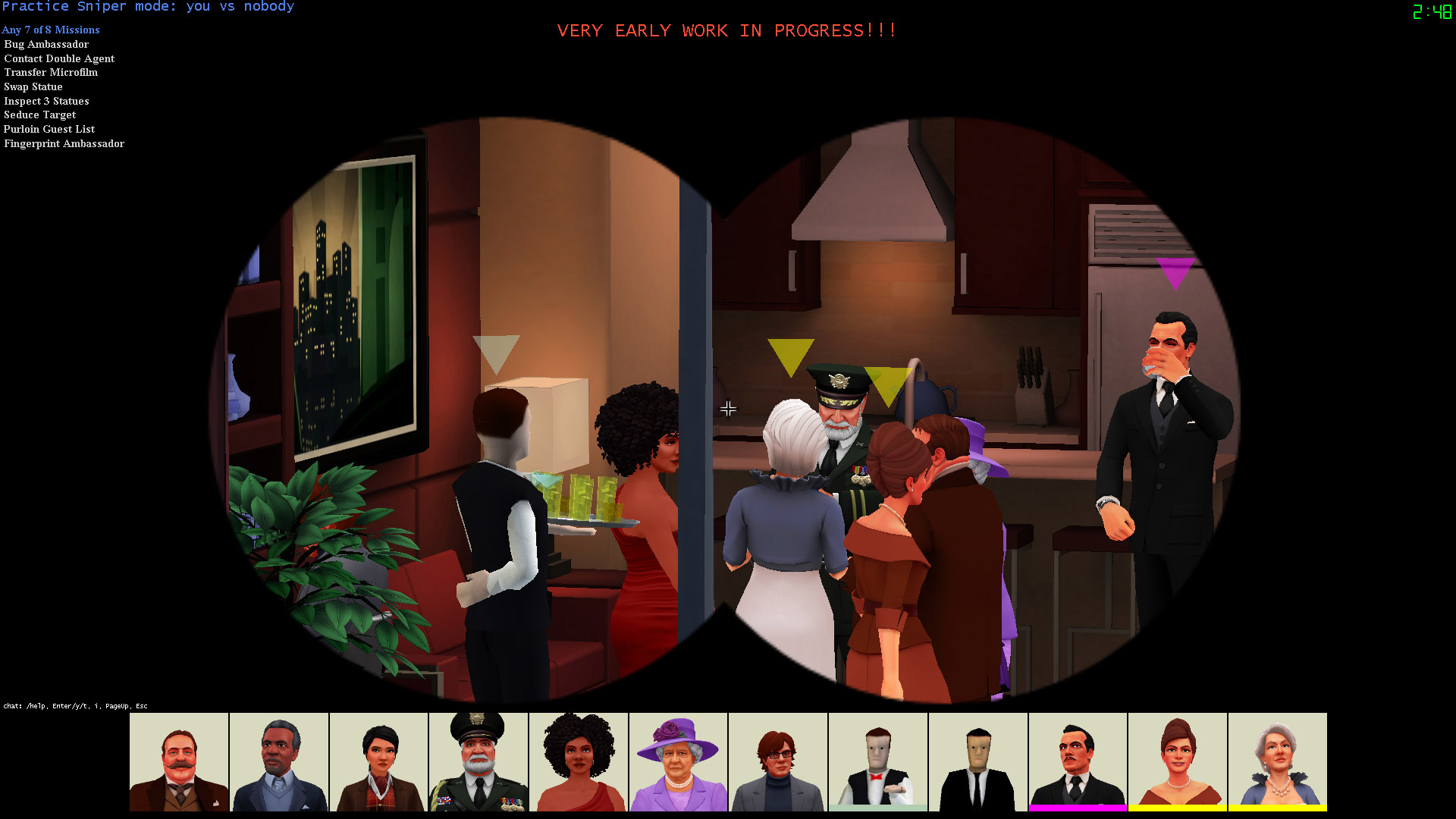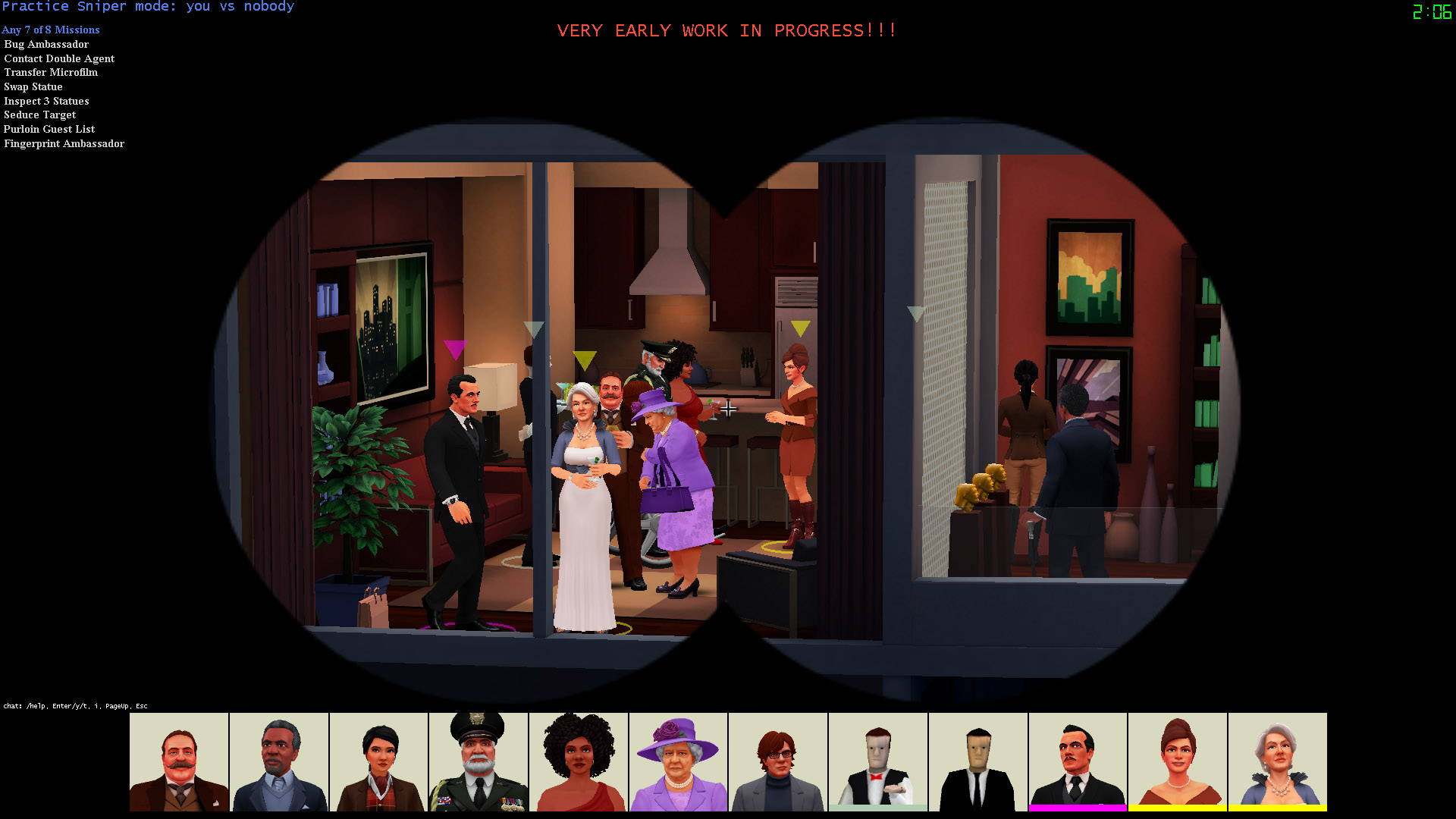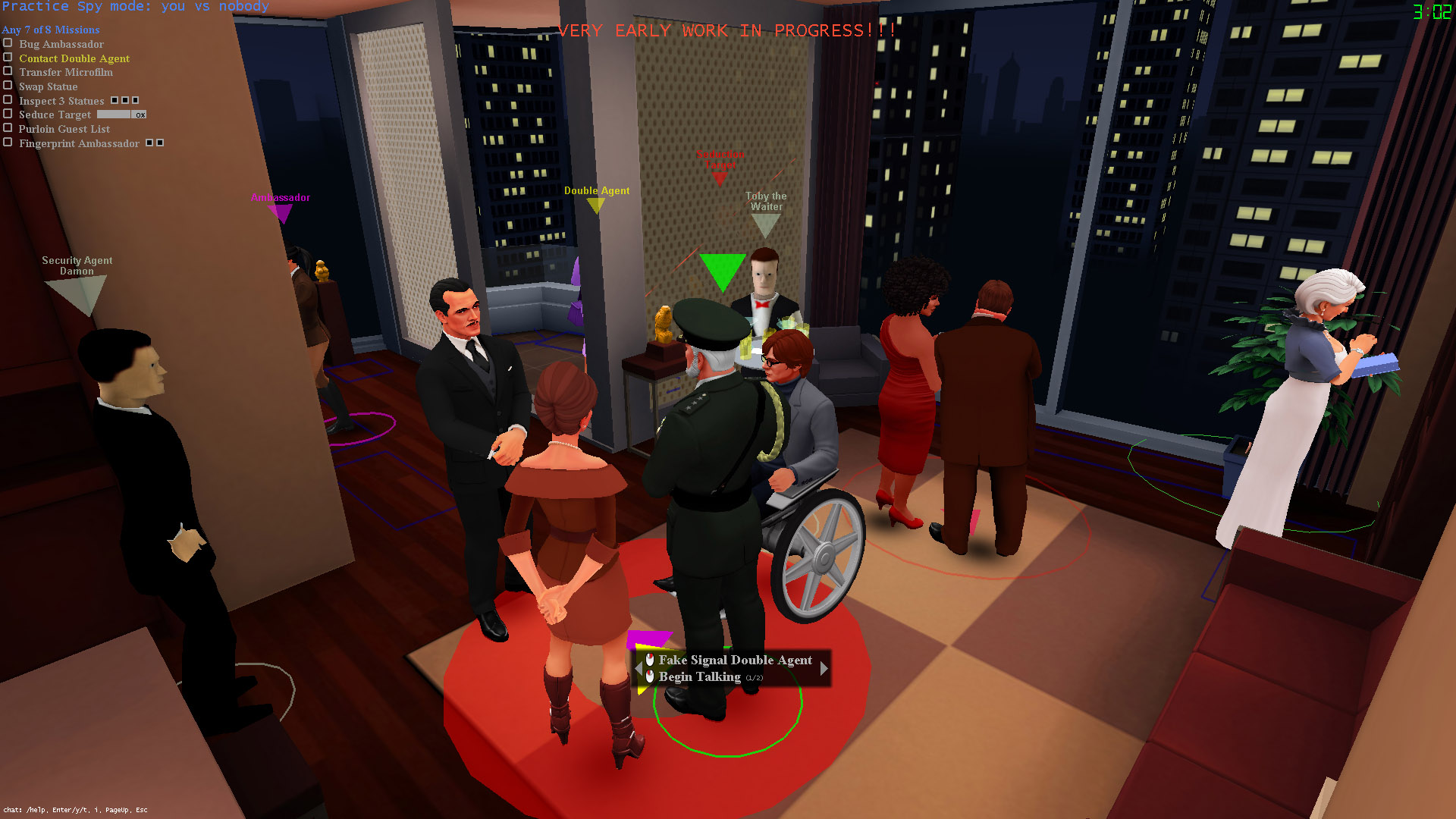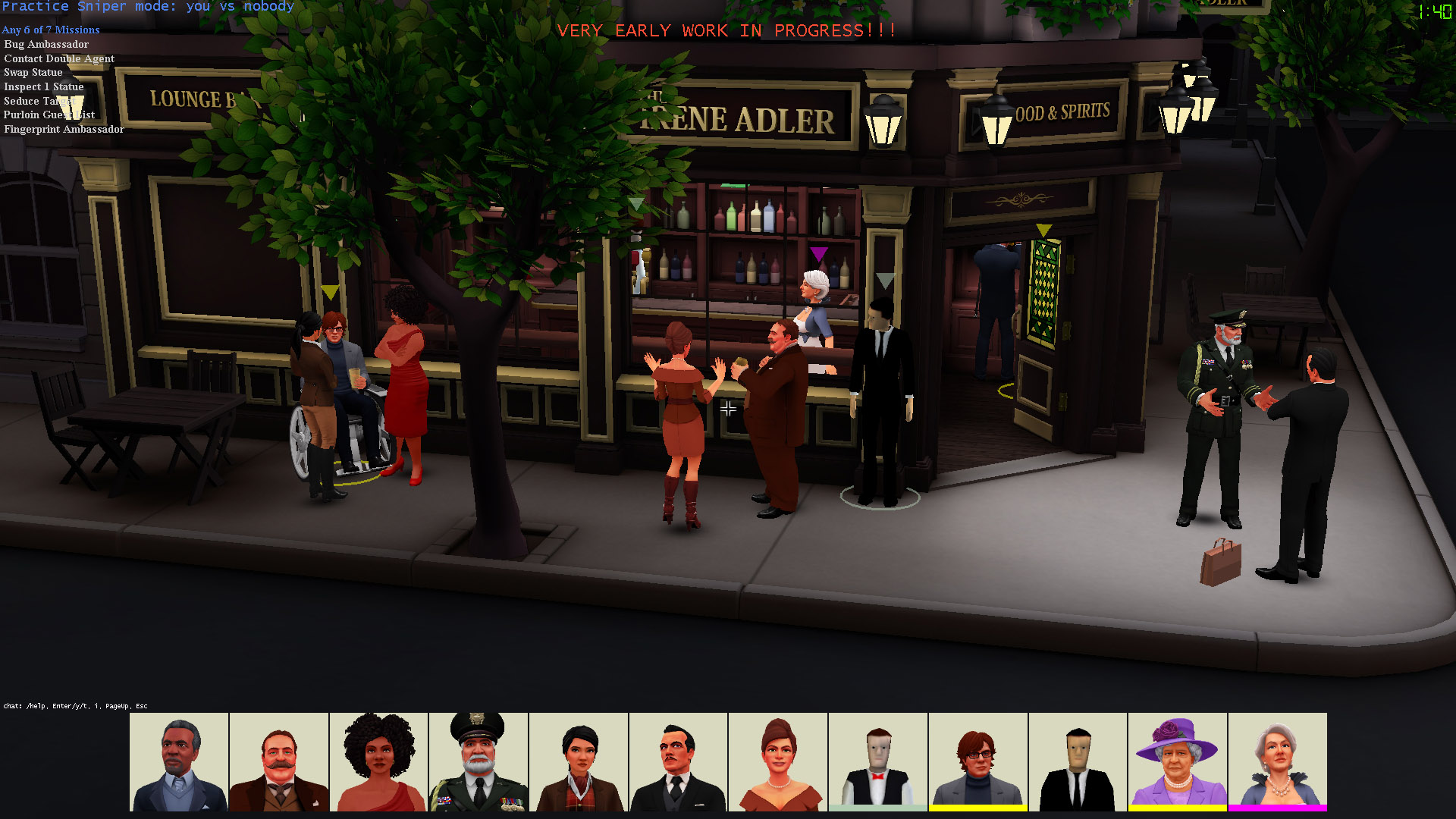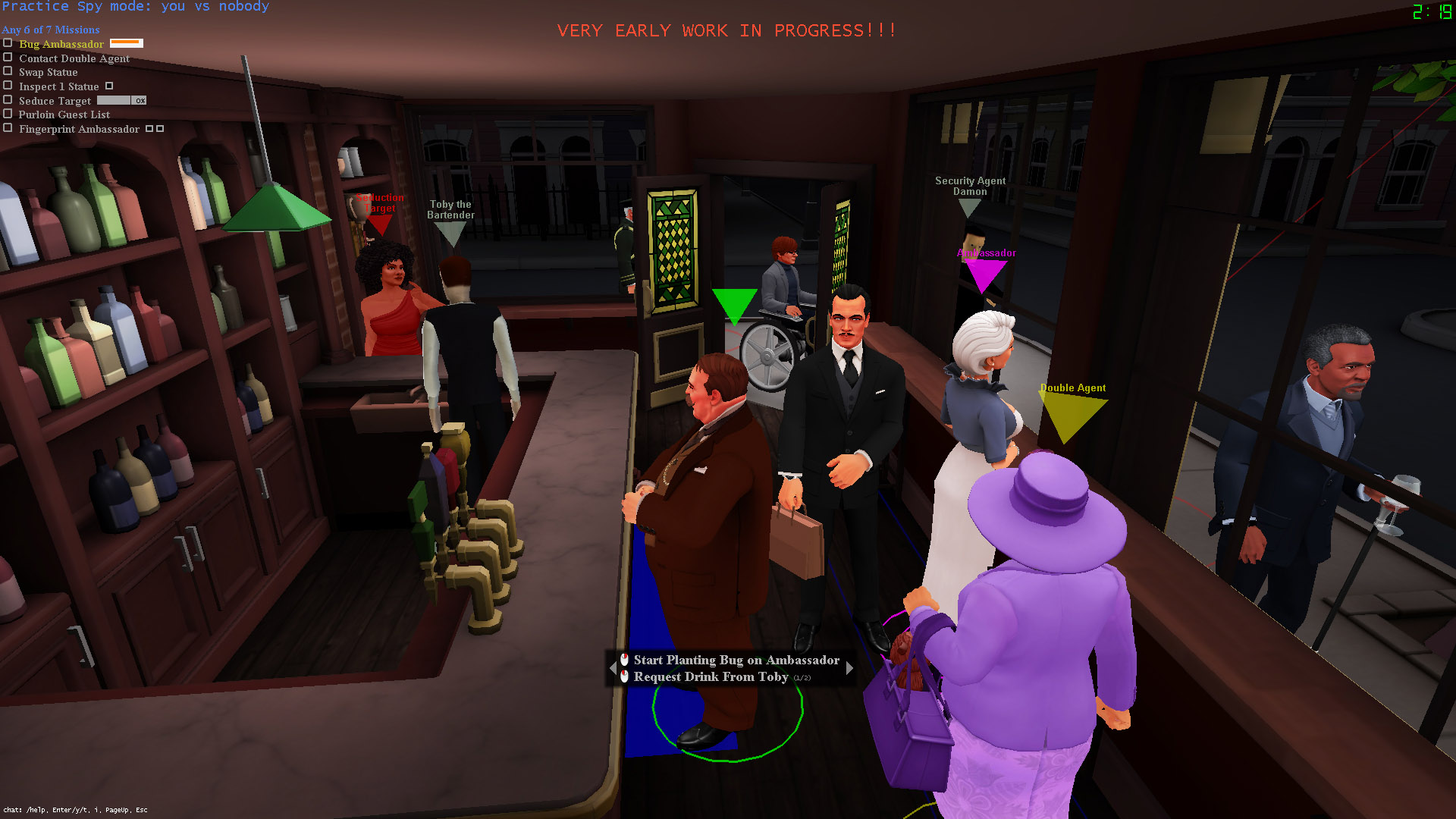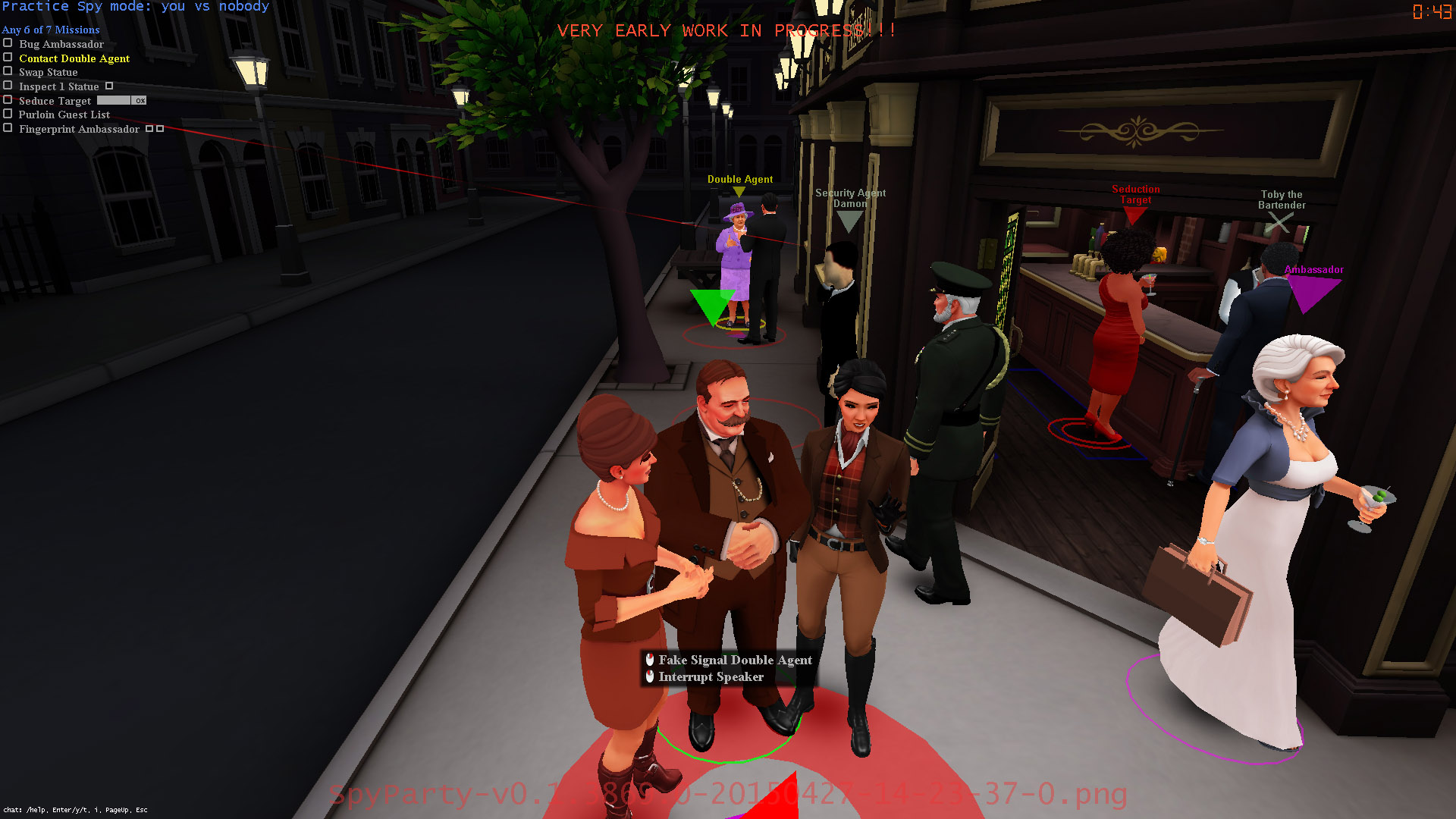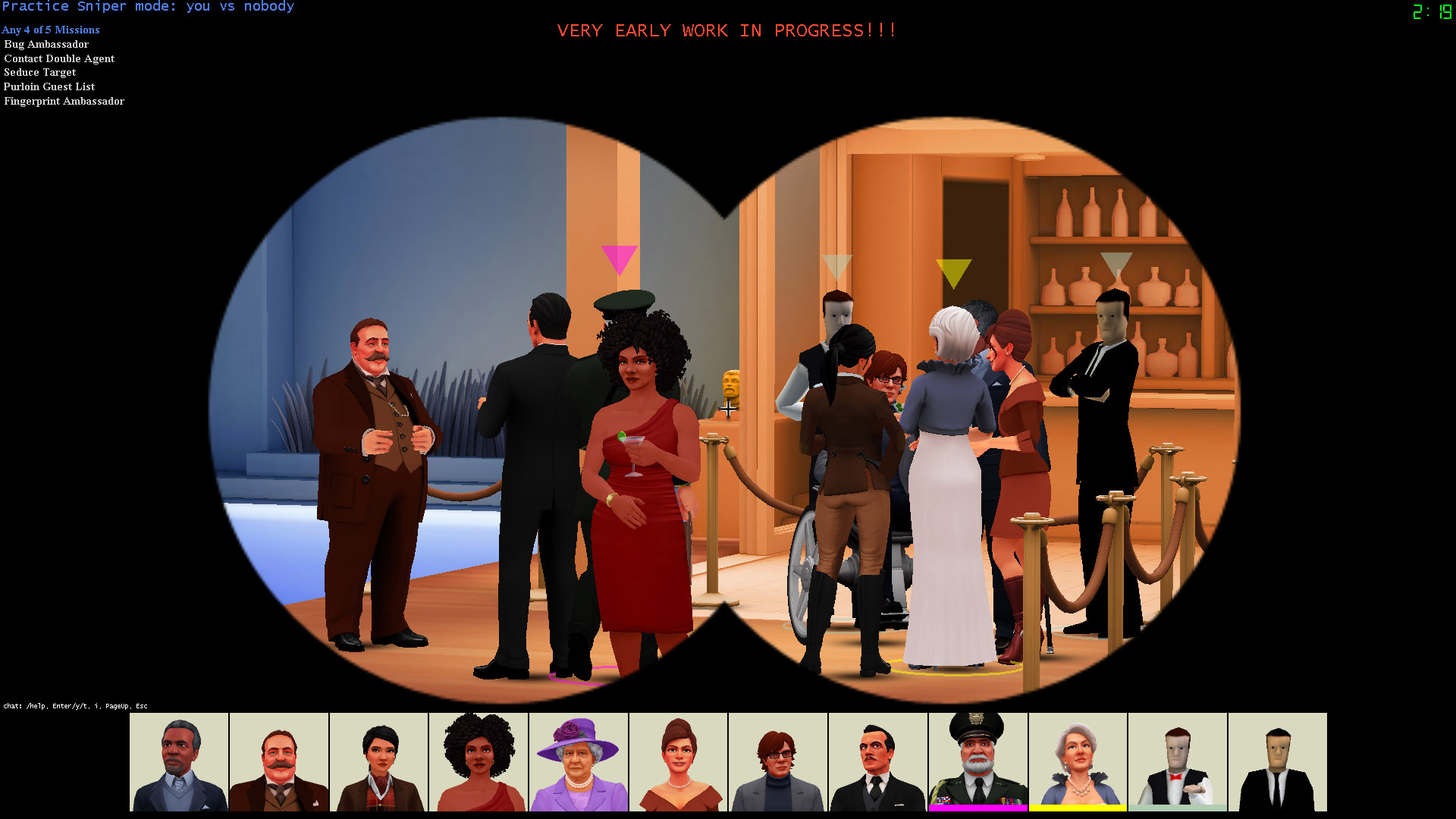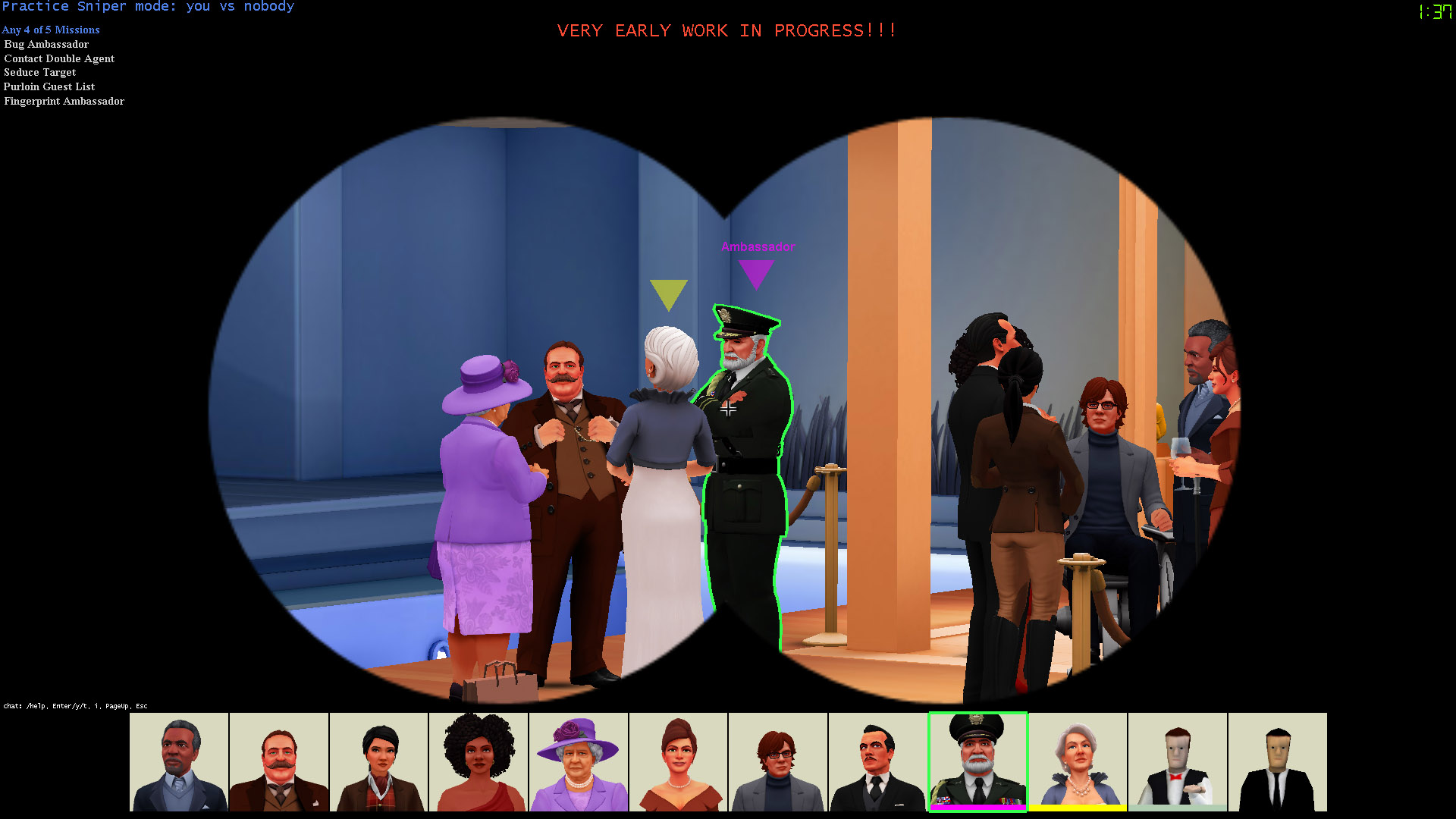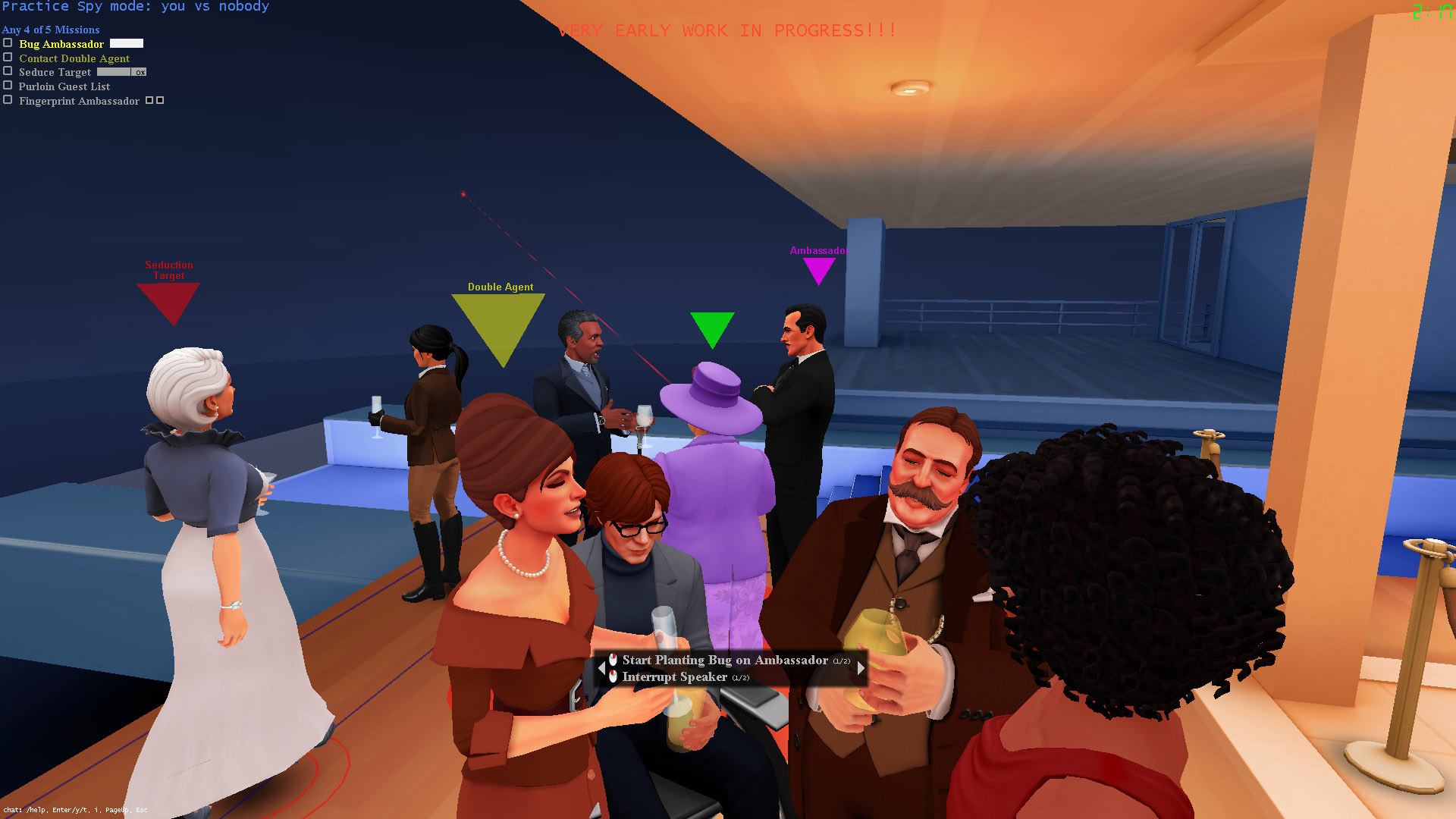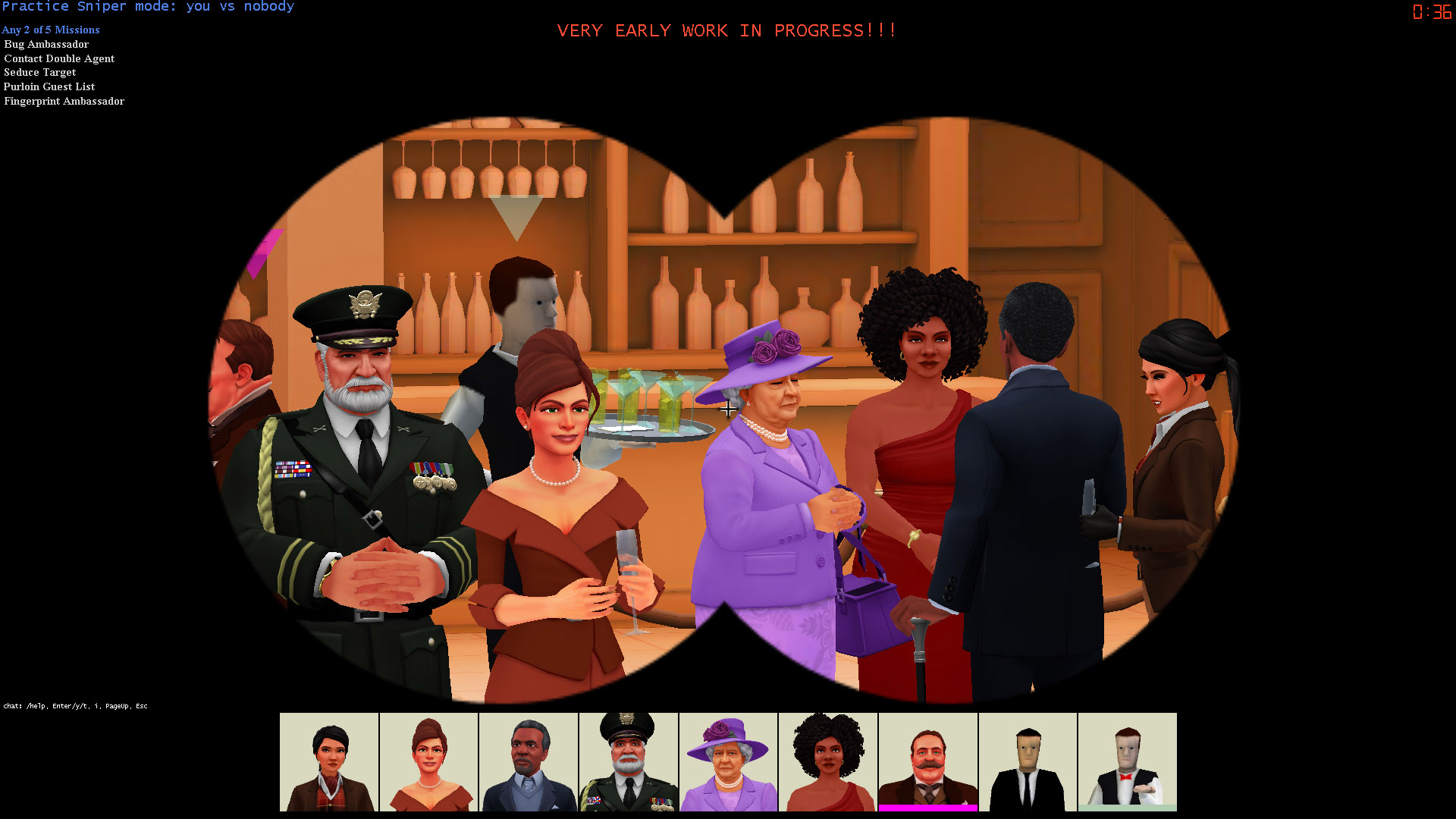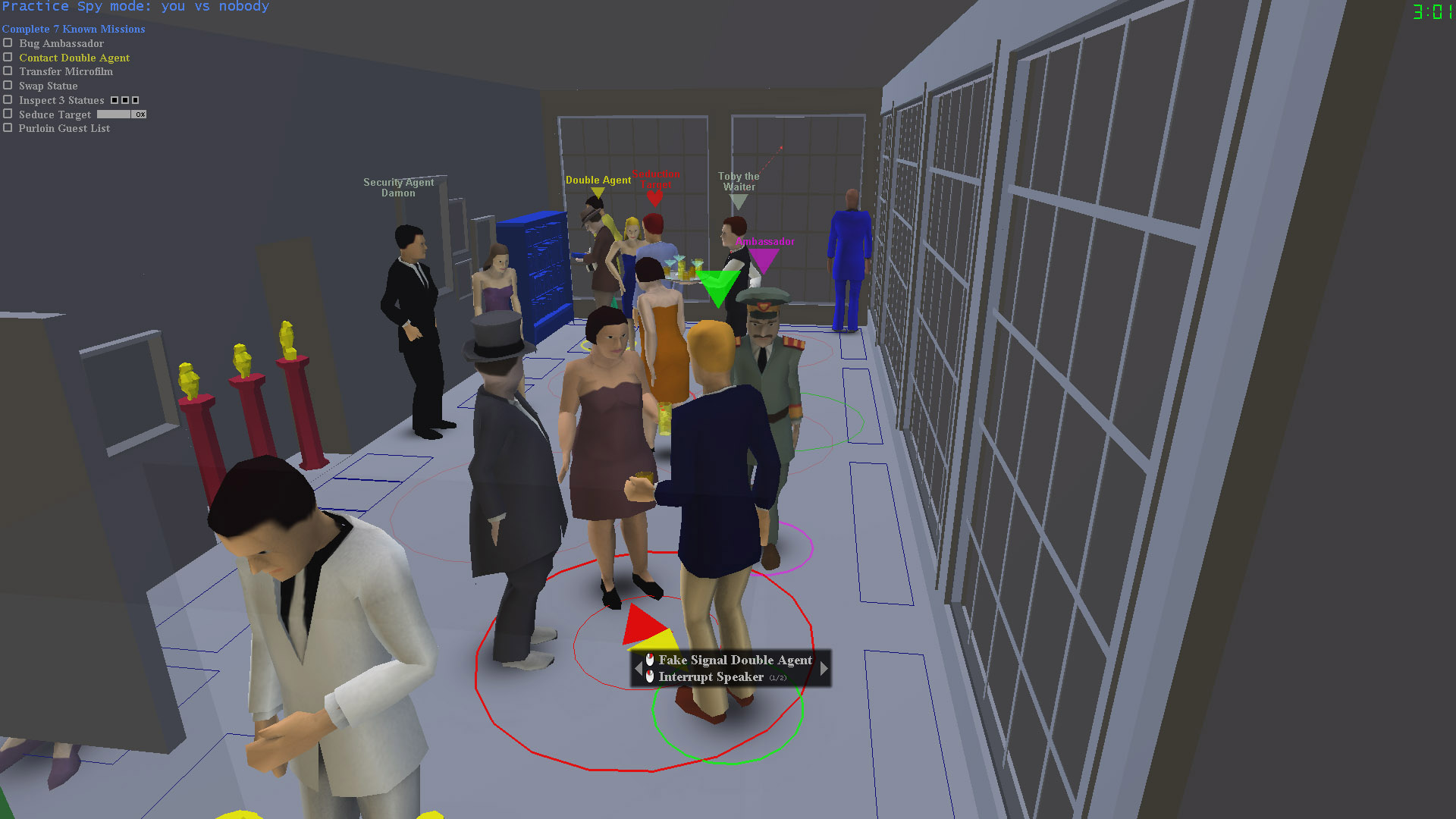
I have a lot of stuff queued up to post about, but the other day, tytalus was playing theinfamousnolan and they were streaming both sides, and this game happened, and I simply had to write about it.
First, since Nolan’s the Sniper in this game, you can sort of play along with him, so watch this first:
Now, here’s Tytalus’ side, where he’s playing Spy:
Now, on first viewing, you might not be that impressed. “He got lucky”, “Nolan made a mistake and shot too early”, end of story, right?
I don’t think so. I think this is a perfect game of SpyParty, and I’m going to analyze it fairly closely to explain why.
It’s important to point out the title of this post is A Perfect Game of SpyParty, not The Perfect Game of SpyParty. I don’t want to imply this is the only or the best way to play. Any deep competitive game—which is what I’m striving to create here—needs to make multiple overlapping strategies available to the players at any one time, and the players need to constantly react to the current situation to choose the best one, or the least-worst one. However, this particular game exemplifies the pinacle of a certain style of SpyParty play, and I want to talk about why.
The whole thing’s a set up. A scam, a frame job.
One of the advanced ways to play SpyParty as the Spy is to try to “frame” an NPC, and get him or her shot by the Sniper. This is quite distinct from the Sniper choosing to shoot the wrong person even though you were trying to complete your missions; that happens all the time, even in elite games. Framing somebody is a step beyond that, where the Spy spends precious time doing certain actions in a certain way to try to implicate another partygoer, to “help” the Sniper shoot the wrong person. There’s a halfway strategy of just trying to get a lowlight for yourself, or getting a highlight for somebody else, and then using that as cover for doing missions as well.
It’s a risky gambit, because you can waste a lot of valuable time trying to frame somebody, and it’s very hard to recover when you’re running low on time, so you have to be careful if you’re going to choose this path. Also, you have to have a fairly high level of micro skill so you can be pretty confident of being able to act like the NPCs convincingly while you’re framing another one, and to hit green Action Tests on missions, both of which which are important to effectively frame someone.
I think Tytalus’ play here exhibits incredible observation, strategy, patience, and yes, luck, or more correctly, being able to take advantage of luck when it comes your way. I would have screwed this game up at multiple different points as Spy, and I’ll try to note those below as I talk about the game.
Observation
Tytalus’ observational skill was in play long before he started talking in this game. He almost ran into “the Red Dress” (Cybil Disobedience) at the statues immediately on spawn (0:11), but since this is the Time of Chaos™ you can get away with a lot of jerky movement and direction changes during this beginning phase, so he just bails from the statue and goes to hang out in a conversation to see where things settle out. This is the first place I would have screwed up. Since the Spy spawned near the statues, I almost certainly would have at least done an Inspect Statues, and probably would have earned a highlight for my troubles, which also would have made Cybil bail from the statue and go do something else. I’m too focused on completing missions as the Spy to observe subtle details about the party flow.
At this point, Tytalus is watching Nolan’s laser (which you can see if you set the video to HD with the little gear icon) to see what he’s looking at. He also checks his twitch.tv chats and answers one about contacting the Double Agent. He notices that Cybil goes straight from one statue to another, which while not exactly rare, is certainly a reason to be suspicious of somebody and probably got Cybil highlit if she wasn’t already from her “statue rush”. This is the second place I would have screwed up, because I wouldn’t have noticed that Cybil was the object of the Sniper’s attention for the back-to-back statue visits.
Tytalus moves to the conversation group containing the Double Agent at 0:37.
Strategy
At this point I think Tytalus has formulated a plan for framing Cybil and getting her shot. At 0:45, from the safety of a conversation, he says, “Now he’s watching the Red Dress pretty heavily, so what I don’t want to do is scare him off right now.” This means that if Tytalus had gone and done the Contact Double Agent action right then, the audible tell of “banana bread” would have immediately eliminated Cybil as a suspect because she was still at a statue. This would have made her impossible to frame, so it would have gotten a mission done but flushed the opportunity to frame down the toilet. I probably would have done that, making three mistakes.
Tytalus says he wants Cybil to go into a conversation and talk, so then he can hit a green Action Test on the Contact, making it look like he’s not talking but she is, and probably increasing Nolan’s suspicion of her. Tytalus doesn’t know for sure he can hit a green Action Test, because it’s hard, but it’s worth a shot, and if he waits for her to talk, even if he hits a white action test and talks himself, she’ll still be talking and be more suspicious than he is due to the statue visits.
Patience
“Red Dress should chat…c’mon Red Dress, chat! Chat, damn you!”
Although frustrated that Cybil isn’t talking, Tytalus is incredibly patient here. He’s in a conversation with the Ambassador (who is in range for the bug!) and the Double Agent, and he still plays it cool. He knows Nolan is not seeing any real tells, so is stewing in his own juices, manufacturing suspicion and starting to panic that he’s missing something. He knows this because this is what Snipers do—this is what human brains do—they see patterns even if there aren’t any. Similarly, Nolan knows Tytalus is higher ranked than he is, so he’s panicking even more that Tytalus is just invisible due to their skill gap, but is still accomplishing missions, and Tytalus knows Nolan is thinking this.
The Ambassador and the Double Agent leave the conversation, and he still plays it cool: “I don’t even care, I don’t care if there’s no…” (1:03)
I would have chased one of the two of them, or gone and done a seduce, or a statue mission. I would have been sweating the clock, since I’d wasted so much time trying to frame Cybil.
Luck
But, Tytalus is patient, and stands there as the clock ticks down. He knows Cybil has to go talk at some point, and at 1:21 his ship comes in. Cybil chases the Double Agent and the Ambassador, and then sidles right up to the Ambassador, as if she wants to cuddle (or bug) him.
Boom, headshot.
“YES!”
Poker versus Go
Now, you might say luck was a huge part of this, that it was the thing that won the game, but I don’t think so. Luck played a major supporting role to be sure, but it was Tytalus’ read on the situation, and his steadfast refusal to screw up an opportunity for a good thing to happen that won him this round. I bet, even if Cybil hadn’t landed right next to the Ambassador, or had gone to a different conversation circle, that Tytalus would have still gotten her shot. He’d played brilliantly up to this point, dealing with bad luck (like Cybil not talking for 30 entire seconds, an eternity in this game), and so I don’t see why he wouldn’t have responded to whatever else happened with the same virtuosity unless things had gone completely unpredictably pear-shaped.
In poker terms, he was dealt a good hand, he turned it into a great hand with consistently excellent play, and he got dealt the perfect card on the river to take him unambiguously over the top.
I am a strong believer in luck and I find the harder I work the more I have of it.
Benjamin Franklin
Go has always been my favorite game, what I would consider the most beautiful game designed by humankind. When I first started designing SpyParty, my goal was to aim for Go, with its crystaline precision, its complete lack of randomness that would—I believed at the time—dilute the player-skill aspects of a game.
Over the years, I learned more about the very different beauties of Poker, and I began to realize regardless of where I wanted to aim design-wise or what my own preconcieved aesthetics were, when I allowed the game to lead the design naturally, when I listened to the game, SpyParty was actually heading towards Poker, with its beauty coming from probabilities and expected values and seizing the opportunity as it’s presented.
I certainly don’t expect SpyParty will ever be as well-designed as Go or Poker, but I am happy that it’s inching in the direction of allowing play at the level exhibited in the game above, and I plan to encourage this and take it even deeper.
If you’re interested in this topic from a game design standpoint, you really must watch two lectures:
If you’re interested in watching games at this level, you should follow some of the elite level SpyParty streamers on twitch:
And, yes, of course playing the game is good too! More invites will go out tonight, and the open beta is coming soon!